
by Sandy Ludington
June 12, 2026

Eisenhower had a famous quote he used repeatedly with some different variations, and it’s pretty well-known today: “The plan is nothing. Planning is everything.”
Eisenhower recognized that a plan would never actually represent reality. You can never expect that the plan will flawlessly proceed once, as Mike Tyson famously said, “you get punched in the face.” But the act of planning surfaces risks, exposes dependencies, challenges assumptions, and informs all the participating people and organizations so they can make better decisions. Without a plan, and the planning activities that produce it, you are hopelessly lost.
In product development, you need a plan, just as Eisenhower did in World War II. More importantly (and just like Ike), you need planning. A static expression of the basic expectations for the product development process will not teach you much.
At Novellum Partners, we encourage an analytical approach, evaluating risks to the development program and considering possibilities statistically. Especially with new technology development, there are important unknowns. Risks may lead to additional commitments, for instance if a test program reveals the need for additional development activity or if a component must be sourced from a more expensive supplier than anticipated. Even if these cannot be expressed with precision, modeling their influence helps decision-makers at all levels bound their expectations for the future and understand how they should respond when things deviate from the baseline plan. Novellum Partners uses a suite of internally developed analytical tools to ensure consistent methods, surface meaningful insights, and avoid the errors which plague bespoke analyses (think of the horrors of a 39-tab spreadsheet).
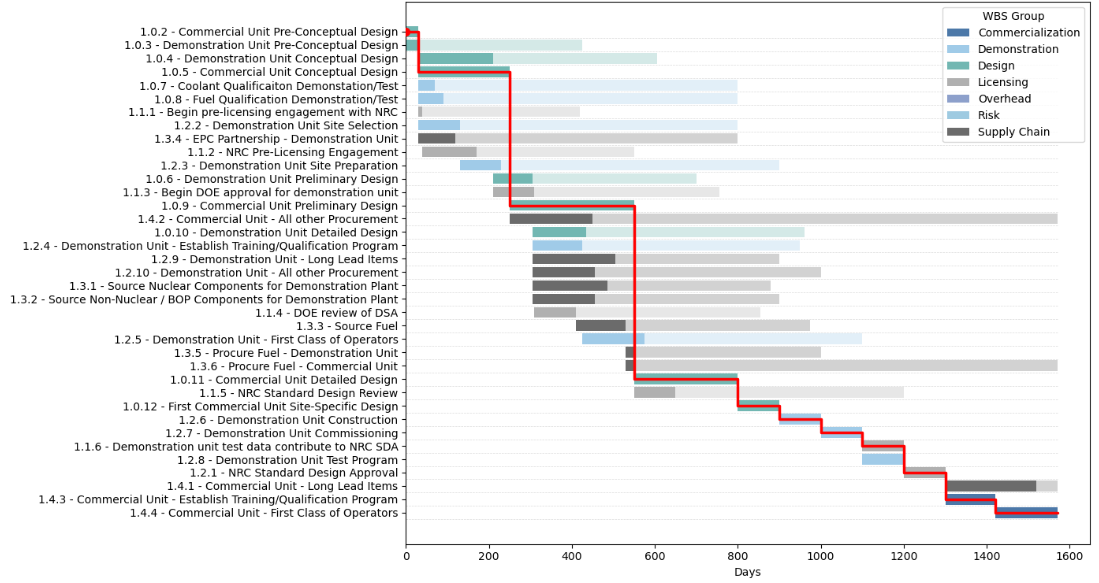
One of the simplest examples of the value obtained from this approach is the overall expectations for the cost and duration of a product development program. Like any complex project with uncertainty and interdependencies between the various activities, the real-world experience is likely to take longer than the baseline “plan” suggests. To illustrate this, we created a basic technology development program with 47 activities and risks (things like design, testing, licensing, and supply chain development) and set logical relationships between them to create a schedule. The baseline plan for this fictitious development program calls for 1,570 days. Its Gantt chart is shown below, with the critical path in red:
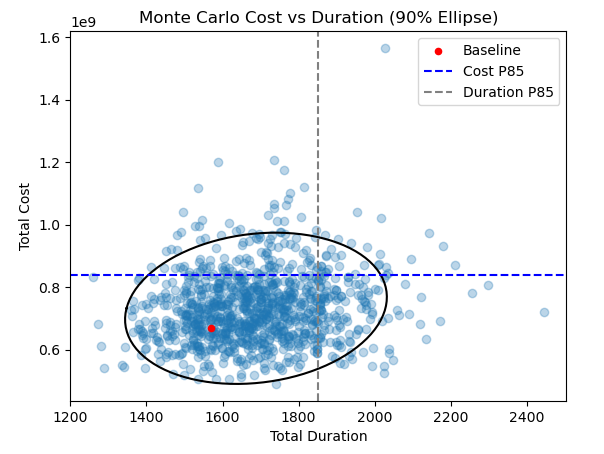
But when we analyze this schedule statistically, with risks and uncertainties that strain these predecessor/successor relationships and sometimes extend activities, we find that only 25.7% of outcomes actually meet or beat the goal (or baseline) of 1,570 days! It’s actually more likely the program will take between 1,600 and 1,800 days and leaders looking to secure enough funding and set commitments with contingency would likely base their actions on an even higher number (like the 85th percentile of the statistical results). A distribution of the statistical outcomes is shown below:
This type of analysis is common in major construction project execution, but it should also be a part of complex product development programs. And because product development is not the same as construction project management it needs some tailoring to meet the needs of a product development organization. When built to support a development program, it becomes indispensable in making overall program estimates, but also in identifying the major contributors to cost and schedule overruns, and the key assumptions your success depends on. Without it, you will struggle to give investors and other stakeholders realistic expectations, to judge the real significance of risks, and to manage development generally. There is also a great deal more that can be derived or supported by this type of analysis – to inform investors, manage risks, drive staffing decisions, etc.
At Novellum Partners we dive into this type of analysis – using our established analytical tools to evaluate the baseline plan, consider risks, model outcomes, and translate results to support decision-making, investment, and resource allocation. If you’re developing a complex technology, managing investor expectations, and planning for commercialization, lean into these questions and prepare your program for success. You’ll be glad you did.