
by Sandy Ludington
December 9, 2025
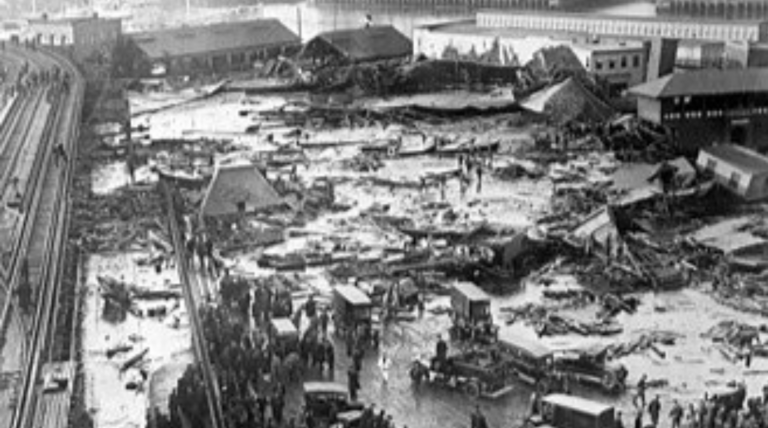
Wreckage from Boston’s Great Molasses Flood
In a recent discussion between a client and an OEM, evaluating operational implications of design decisions, the equipment vendor was asked, “What happens when it breaks?” in response to the vendor’s description of a novel (and complicated) component design.
The response was fast and straightforward: “We’ve designed it not to break.” Given that the OEM’s goal for the meeting was to inspire confidence in their technology with a potential customer, let’s just say their desired outcomes were not achieved.
While much can be done in design and construction to minimize and mitigate potential failures, experience shows that everything has the potential to break, and more often than desired it happens – and in ways we didn’t anticipate. Effective design processes anticipate this potential, and prepare for the day when a meaningful, unexpected failure strikes. This isn’t to say that designs need to be prepared for every eventuality, or that redundant systems should be required to completely eliminate a system’s sensitivity to failures. But potential consequential failures or unanticipated conditions must be considered. Resilient designs are fundamental cornerstones to achieving a resilient organization. An organization that neglects to understand or prepare for potential failures undermines its own resilience.
A good example in the U.S. nuclear power industry was the series of steam generator replacements in U.S. PWRs in the late 1980s through the early 2000s. Early design decisions did not appreciate the extent to which evolving operating conditions were pushing the limits of selected materials and design features. The result was two undesired and expensive outcomes. First, tube degradation necessitated tube-plugging and in some instances costly down powers. Second, when plugging was no longer acceptable and steam generator replacement was needed, utilities found that the power plant layout and configuration were not designed to consider such an activity. The result was expensive, intrusive, long, and very complex projects to perform the replacement. In some cases the owner elected to instead prematurely close and decommission the power plant. Today’s plant designs benefit from those learnings, with operating conditions and materials that are expected to avoid significant plugging or component replacement, and in the unlikely event replacement is necessary, layouts and configurations that anticipate that need and would make the replacement straightforward.
Imagine if those risks had been contemplated, identified, and addressed in the early design of the operating plants? How much cost and effort could have been avoided?
This is not a concept unique to nuclear power plants, or any power plant for that matter. It applies to any major undertaking with consequential risks.
Bringing a de-risking and rigorous specification and review mindset to design and planning is a hallmark of Novellum Partners. We apply our experience-based insights in large capital projects, risk management, power plant design and engineering, and the application of high reliability principles to these challenges. Our mission is to enable clients to achieve their intended outcomes, not to watch them walk back commitments or for customers to invoke warranty clauses in contracts.
Commonly invoked in aviation, oil & gas production, and healthcare, the principles of a high reliability organization are a foundation of our approach:
- Preoccupation with Failure: Constantly anticipate and examine possible failures—no error is too small to ignore.
- Reluctance to Simplify: Avoid oversimplifying interpretations; treat complexity as a source of insight.
- Sensitivity to Operations: Maintain a deep situational awareness of frontline operations.
- Commitment to Resilience: Build capacity to detect, contain, and recover from errors and unexpected events.
- Deference to Expertise: Empower those with the closest knowledge and expertise to make critical decisions.
These principles can (and should!) be applied to design and engineering as well. Deliberate, thorough work early on is the best defense against unanticipated problems in the future.
Let Novellum Partners prepare you to lead with eyes wide open – and to deliver technologies and products designed for resilience.